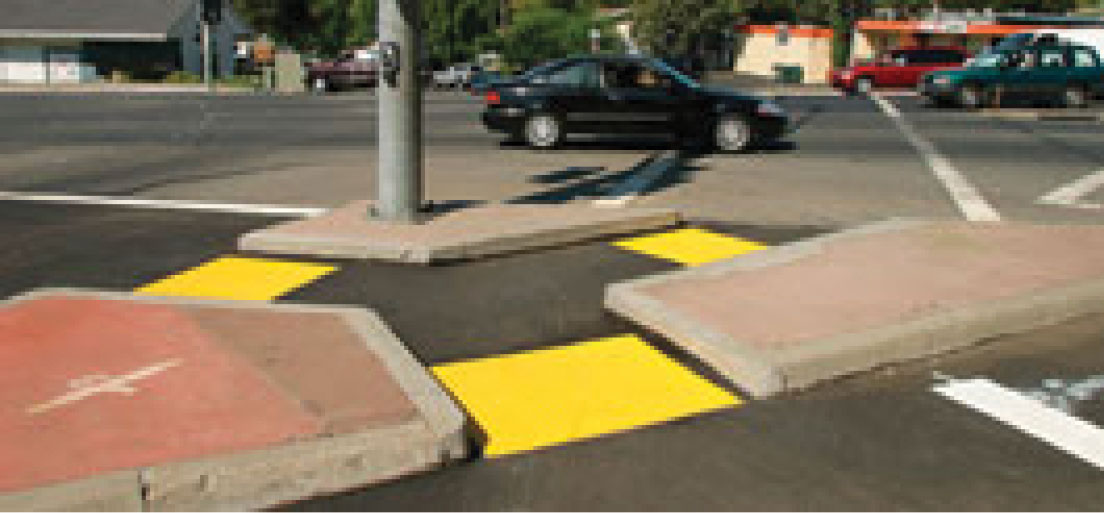

Access® Tile’s detectable warning tiles are specifically created to allow persons of all abilities to navigate any space safely, through the use of wayfinding bars and truncated domes. Truncated domes serve as a detectable warning, which can be seen, felt and heard. Detectable warning systems are put in place to increase the accessibility and safety of public spaces. Together, truncated domes and wayfinding bars create a detectable warning system to safely guide all members of the public. Detectable warning pavers increase the safety for people of all abilities in your community, and allow everyone to enjoy public spaces. There are several regulations and codes all detectable warning products must meet to be considered compliant. These include the Americans with Disabilities Act (ADA), the Public Right of Way (PROW) and the California Title 24 Requirements. The use of an ADA detectable warning systems makes public spaces more enjoyable and accessible for all members of the community.
Every one of our detectable warning pavers is designed with these ADA regulations in mind, and tested rigorously to ensure they exceed even the most stringent standards for Access® Tile uses the following tests to ensure our ADA compliant tiles are durable, cost-effective, and meet all required specifications and regulations: the AASHTO HS20-44 wheel load test, ASTM Concrete tests, and ASTM D tests.
These detectable warning surfaces guide the public using a combination of wayfinding bar tiles and truncated domes. The truncated domes, aligned according to ADA guidelines, alert all persons when they approach the edge of a path, serving as a detectable warning. Detectable warning pads are commonly used in transit stations and pedestrian crosswalks, to alert individuals, especially the visually impaired, when they reach an unsafe edge. Each ADA tile and ADA dome also reflects sound, which assists individuals who use guidance canes to navigate the space, unaided. Our truncated domes have been expertly engineered to create the ultimate solution in tactile walking surface indicators (TWSI). Each ADA detectable warning product increases the safety of public spaces, and serves to allow individuals of all abilities to enjoy public spaces.
ADA detectable warning requirements ensure spaces open to the public can be enjoyed, and accessed, by all members of the community. The use of truncated domes plays a major role in creating a more accessibility friendly space. ADA detectable warning systems are required by law in many places. The combination of truncated domes and wayfinding bars creates a detectable warning system that enhances the safety of any space, for people of all abilities. The use of detectable warning pavers allows the visually impaired to navigate spaces safely, without guidance.
Americans With Disabilities Act (ADA)
The Americans with Disabilities Act (ADA) became law in 1990 and recognizes the rights of persons with disabilities in every area of daily public life. This act prohibits discrimination of disabled persons in terms of jobs, transportation, and in all areas accessible to the general public. To ensure all spaces open to the public are accessible and usable to people with disabilities, the government established the ADA standards and the ADA Accessibility Guidelines or ADAAG. Detectable warning requirements aid in the standardization of accessibility across the nation. By implementing detectable warning systems, your community can become a more inviting and enjoyable space for personals of all abilities.
Part of the ADA standards calls for the installation of truncated dome tile in spaces open to the public. This includes, but is not limited, the installation of concrete detectable warning pavers in areas such as, pedestrian crossings, parking garages, escalators and stairs, wheelchair ramps, and transit platforms. These ADA detectable warning requirements are crucial in creating an accessible space. The following sections of the ADA Accessibility Guidelines (ADAAG) indicate the requirement of detectable warning surfaces with truncated dome installations.
- R304.1 General. Detectable warnings shall consist of a surface of truncated domes aligned in a square or radial grid pattern and shall comply with R304.
- R304.1.1 Dome Size. Truncated domes in a detectable warning surface shall have a base diameter of 23 mm (0.9 in) minimum to 36 mm (1.4 in) maximum, a top diameter of 50 percent of the base diameter minimum to 65 percent of the base diameter maximum, and a height of 5 mm (0.2 in).
- R304.1.2 Dome Spacing.Truncated domes in a detectable warning surface shall have a center-to-center spacing of 41 mm (1.6 in) minimum and 61 mm (2.4 in) maximum, and a base-to-base spacing of 17 mm (0.65 in) minimum, measured between the most adjacent domes.
- R304.1.3 Contrast. Detectable warning surfaces shall contrast visually with the adjacent gutter, street or highway, or walkway surface, either light-on-dark or dark-on-light.
- R304.1.4 Size. Detectable warning surfaces shall extend 610 mm (24 in) minimum in the direction of travel and the full width of the curb ramp (exclusive of flares), the landing, or the blended transition.
- R304.2 Location and Alignment:
- R304.2.1 Perpendicular Curb Ramps. Where both ends of the bottom grade break complying with R303.3.4 are 1.5 m (5.0 ft) or less from the back of curb, the detectable warning shall be located on the ramp surface at the bottom grade break. Where either end of the bottom grade break is more than 1.5 m (5.0 ft) from the back of curb, the detectable warning shall be located on the lower landing.
- R304.2.2 Landings and Blended Transitions. The detectable warning shall be located on the landing or blended transition at the back of curb.
- R304.2.3 Alignment. The rows of truncated domes in a detectable warning surface shall be aligned to be perpendicular or radial to the grade break between the ramp, landing, or blended transition and the street.
California Title 24 Requirements:
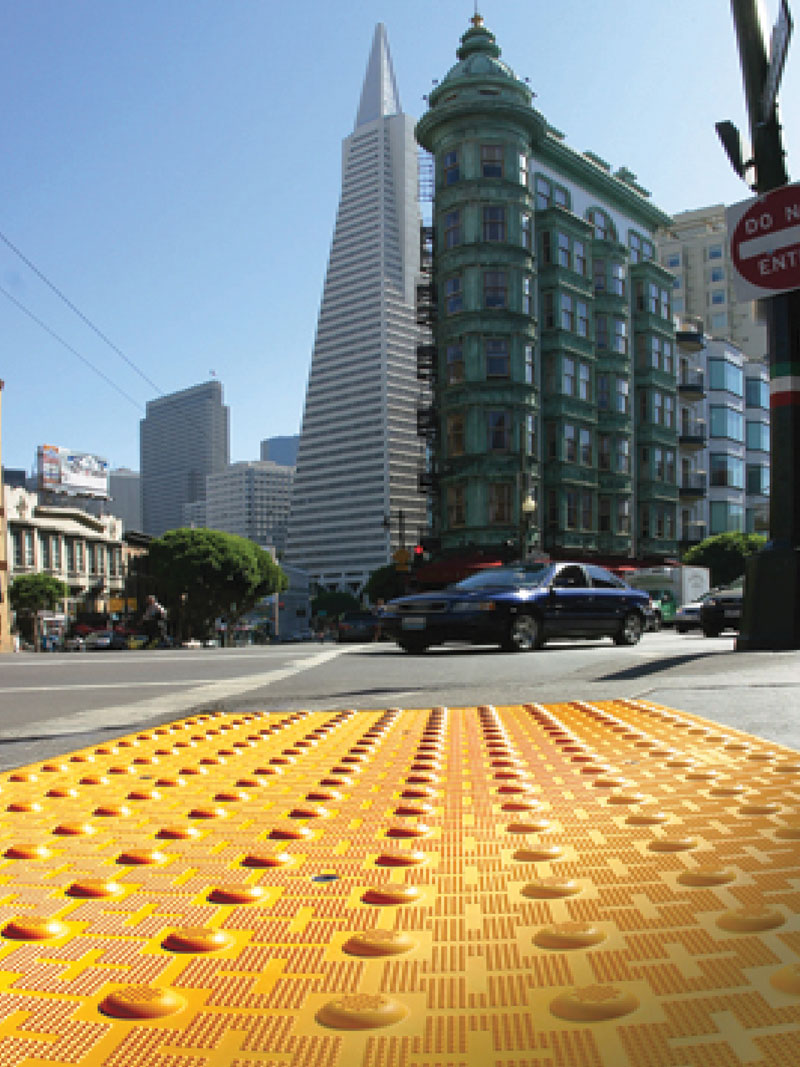
Title 24, or the California Building Standards Code, outlines what standards all buildings are required to meet. This code encompasses accessibility requirements, the California Energy Code, and much more, including various ADA detectable warning tiles, as well as other ADA detectable warning products. The following excerpt from the 2016 California Building Code (California Code of Regulations, Title 24, Part 2, Volume 1, California Building Standards Commission) outlines the code’s requirements for detectable warning tiles and truncated domes.
- 11B-705.1 Detectable Warnings
- 11B-705.1.1.1 Dome size. Truncated domes in a detectable warning surface shall have a base diameter of 0.9 inch minimum and 0.92 inch maximum, a top diameter of 0.45 inch (11.4 mm) minimum and 0.47 inch (11.9 mm) maximum, and a height of 0.18 inch (4.6 mm) minimum and 0.22 inch(5.6 mm) maximum.
- 11B-70S.1.1.2 Dome spacing. Truncated domes in a detectable warning surface shall have a center-to-center spacing of 2.3 inches (58 mm) minimum and 2.4 inches (61 mm) maximum, measured between the most adjacent domes on a square grid.
- 11B-70S.1.2.1 Platform edges. Detectable warning surfaces at platform boarding edges shall be 24 inches (610 mm) wide and shall extend the full length of the public use areas of the platform.
- 11B-705.1.2.2 Curb ramps. Detectable warnings at curb ramps shall extend 36 inches (914 mm) in the direction of travel. Detectable warnings shall extend the full width of the ramp run excluding any flared sides. Detectable warnings shall be located so the edge nearest the curb is 6 inches (152 mm) minimum and 8 inches (203 mm) maximum from the line at the face of the curb marking the transition between the curb and the gutter, street or highway.
- 11B-705.1.2.5 Hazardous vehicular areas. Detectable warnings at hazardous vehicular areas shall be 36 inches (914 mm) in width.
- 11B-70S.2 Detectable directional texture. Detectable directional texture at transit boarding platforms shall comply with Figure 11 B-705.2 and shall be 0.1 inch (2.5 mm) in height that tapers off to 0.04 inch (1.0 mm), with bars raised 0.2 inch (5.1 mm) from the surface. The raised bars shall be 1.3 inches (33 mm) wide and 3 inches (76 mm) from center-to-center of each bar. This surface shall differ from adjoining walking surfaces in resiliency or sound-an-cane contact. The color shall be yellow conforming to Federal Color No. 33538. This surface will be placed directly behind the yellow detectable warning texture specified in Section 11 B-705.1.2.1, aligning with all doors of the transit vehicles where passengers will embark. The width of the directional texture shall be equal to the width of the transit vehicle’s door opening. The depth of the texture shall not be less than 36 inches (914 mm).
- 11B-705.3 Product approval. Only approved DSA-AC detectable warning products and directional surfaces shall be installed as provided in the California Code of Regulations (CCR), Title 24, Part 1, Chapter 5, Articles 2, 3 and 4.
AASHTO M 333-16
Title 24, or the California Building Standards Code, outlines what standards all buildings are required to meet. This code encompasses accessibility requirements, the California Energy Code, and much more, including various ADA detectable warning tiles, as well as other ADA detectable warning products. The following excerpt from the 2016 California Building Code (California Code of Regulations, Title 24, Part 2, Volume 1, California Building Standards Commission) outlines the code’s requirements for detectable warning tiles and truncated domes.
The American Association of State Highway and Transportation Officials (AASHTO) is a standard setting body in the United States, which provides specifications, guidelines, and test protocols for use in highway design and construction throughout the United States. The AASHTO represents and provides standards for all methods of transportation, including air, highways, public transit, rail, and water.
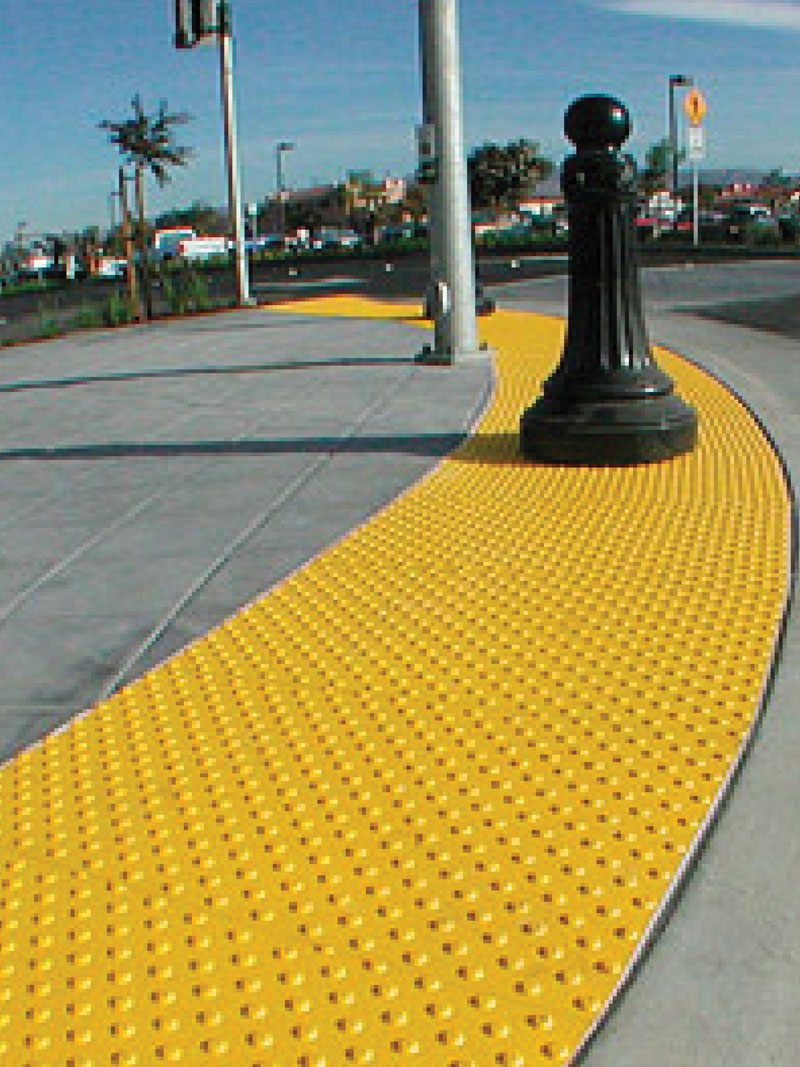
The AASHTO provides clear, standard guidelines in regards to detectable warning surfaces. Specifically, AASHTO M 333-16 (2020) provides sufficient detailed specifications, establishing a standard for detectable warning surfaces.
AASHTO M 333-16 calls for the installation of truncated dome tiles, easily detectable underfoot or by guidance cane, in the transitions to vehicular ways, compensating for the lack of tactile cues caused by the sloped surfaces of curb ramps.
AASHTO M 333-16 compliant detectable warning surfaces, such as AccessTile, have undergone extensive testing by the American Society for Testing and Materials (ASTM). To meet AASHTO M 333-16 (2020) compliance, AccessTile detectable warning surfaces have been tested to meet or exceed the following standards:
- ASTM D638 Tensile Strength
- ASTM D790 Flexural Strength
- ASTM D 695 Compressive Strength
- ASTM G155 Accelerated Weathering
- ASTM C1028 Slip Resistance
- ASTM E84 Flame Spread Index
- ASTM D1037 Accelerated Aging (Freeze Thaw)
- Linear Thermal Expansion ASTM D696-03
- Tile Bond Strength ASTM C1583
Understanding Compliance
R304.1.4 Curb Ramp and Size of Detectable Warning Area
- Full width of ramp excluding flares
- 24″ minimum in the direction of travel
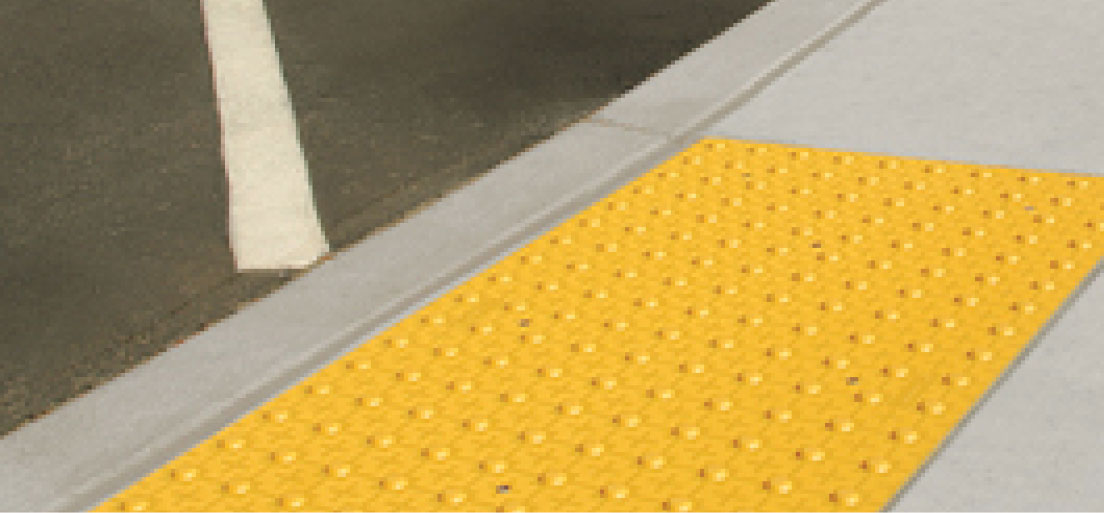
R304.2.1 Perpendicular Curb Ramps
- Grade break less than 5 feet from back of curb
- Grade break greater than 5 feet from back of curb
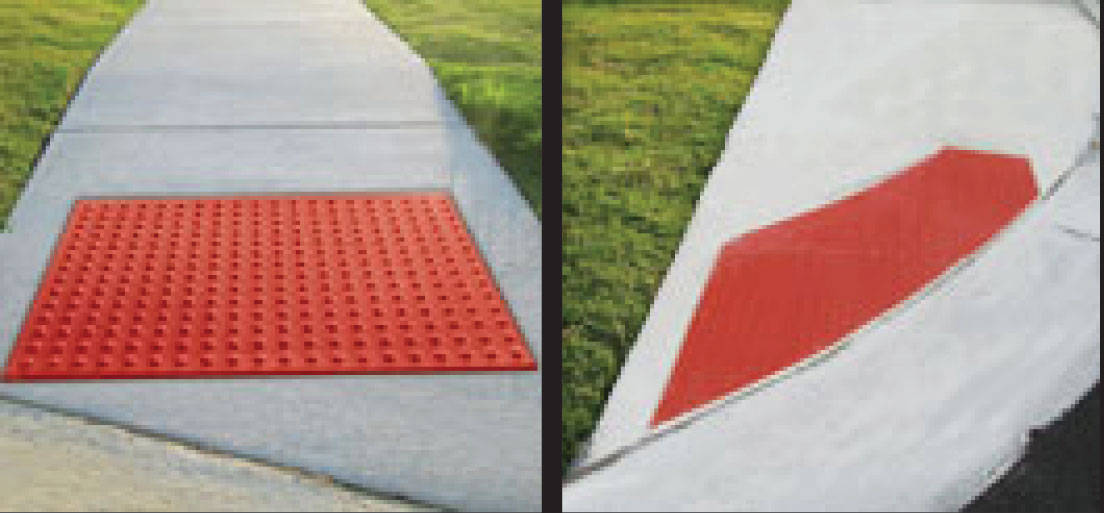
R304.2.2 Landings and Blended Transitions
- Located on landing or blended transition at back of curb
- 24″ in the direction of travel
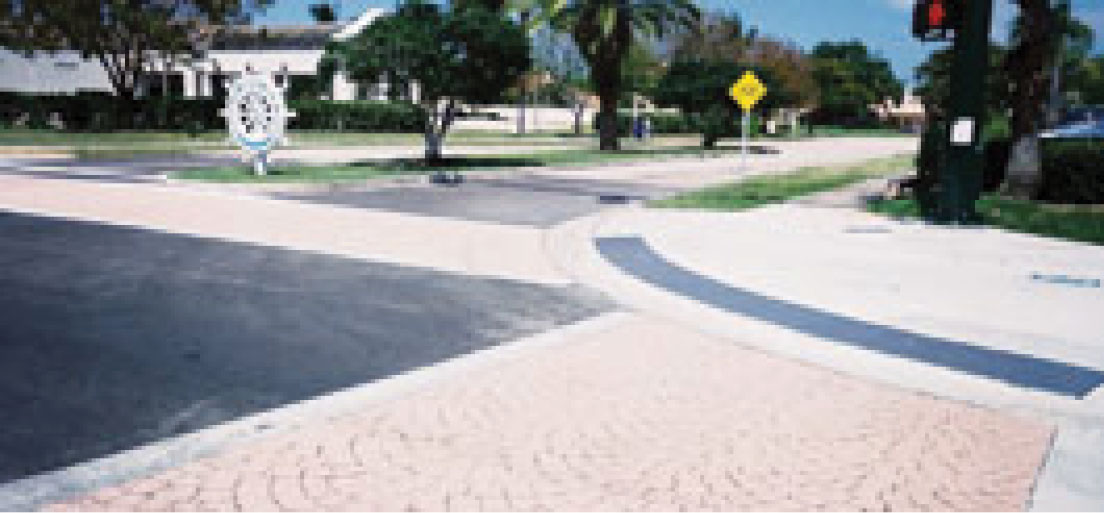
R304.2.3 Rail Crossing
- Edge nearest rail crossing is 6 feet minimum and 15 feet maximum from center line of the nearest rail
- Truncated domes shall be aligned to be parallel with the direction of wheelchair travel
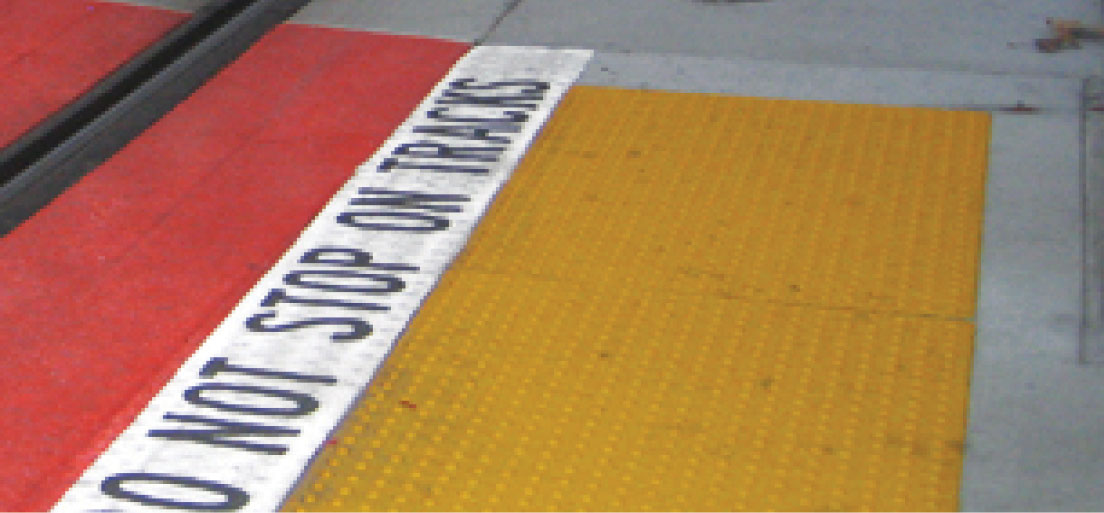
R305.4 Medians and Pedestrian Refuge Islands
- Shall have detectable warnings that comply with R304 at ramps and blended transitions
- At cut through islands at curb line in-line with face of curb and shall be separated by a 2-foot minimum length of walkway without detectable warnings